Our previous article 'Why is Content Marketing important?' delved into why managing your online content should be an important part of your digital content plan.
Marketers love phrases like 'Consumer focused' and indeed all public content from your business should be consumer focused. But consumers, far from being a one size fits all group, are made up of many individuals, with different outlooks, goals and intentions. They range from 'Sunday-driver' types, lazily browsing for articles or flicking through videos or tweets that may interest them in an idle moment, to a focused customer, methodically and exhaustively searching for the right kind of solution for their particular need.
Let's graph these different users onto a kind of 'buying cycle'.
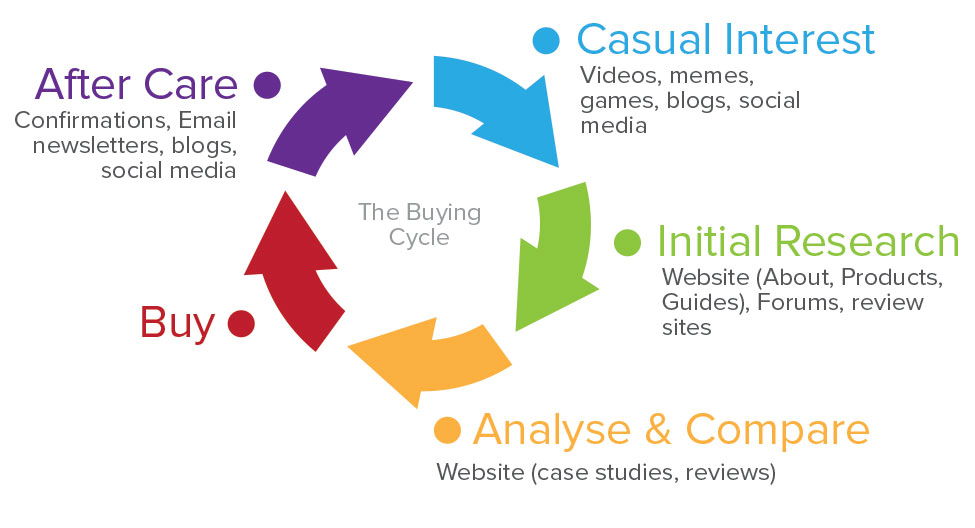
The Casual Interest phase buyer is someone who may be aware they need something but is not yet actively researching. They are piqued by 'fun' or more subtle or peripheral forms of content you may have - such as videos, infographics, memes, games, blogs, social media, etc. They are slowly and unconsciously building up a relationship with you and your business.
In the Initial Research phase, a buyer will now be ready to search and is setting out to actively research their best options. They will now seek out specific information from your site and your competitors'. They will start to narrow the choices down. They may be browsing your site at the top level, looking at Product guides, About pages, How Tos, etc. External sources such as review sites, forums may also play a part here.
The Analyse & Compare phase buyer will be getting down to the nitty gritty. They are close to making a choice, but may still be comparing like with like to get the best price or deal. The kind of content in use here will be case studies, forums, reviews.
Buy phase - the user has committed and is going through your checkout and cart process.
After Care and Loyalty - this buyer can potentially become a repeat loyal customer and may be won over by the quality of 'aftercare' communication. Email newsletters, blogs, social media also play a part here.
In the online world, your website is just the tip of the iceberg. It may serve the purpose of providing the right kind of information to someone who is in the Research or Analyse part of the cycle, but is just too information heavy for someone in the Casual interest phase, or just not what someone in the After Care phase needs. Quite often, it's the other information 'around' the main online presence that will make those connections.
The online platforms available to you to make this connection are endless. YouTube and Vimeo channels, Facebook pages, Twitter and Wordpress accounts are all a doddle to set up, and can all be easily adapted to suit various customer needs.
What if you don't know where to start? Tune in next week for the final instalment in our content marketing series, which looks at devising a content plan.