With Christmas well behind us, memories of the agonising what-to-do-with-the-turkey-leftovers dilemma are a distant memory. Any good culinary manager knows how creative you have to be so that things don't get old fast - Turkey Curry four days in a row just won't cut it. Turkey Tortilla Soup anyone? Turkey Casserole or what about a Turkey Savoury Club Sandwich? The combinations are endless - and all from one item! Rebecca Lieb, an analyst at the Altimeter Group and author of 'Content Marketing', uses the turkey analogy to explain just how important it is to be creative with your content.
A good content marketing strategy takes planning. The most effortless and skilled communicators always manage to impart their information in a seemingly effortless way, hiding the hours of preparation that may have gone into their presentation. Planning ahead is key. Good communication is also targeted - sending the right messages to the right people at the right time has a much better chance at success than the 'hope it sticks' scattergun effect.
Here's our six steps to a top content marketing plan:
- Carry out content audit. What are your current content outputs? Make a comprehensive list of every single piece of online content output - your website, blogs, social media, video channels, email newsletters, email communications between you and your customers.
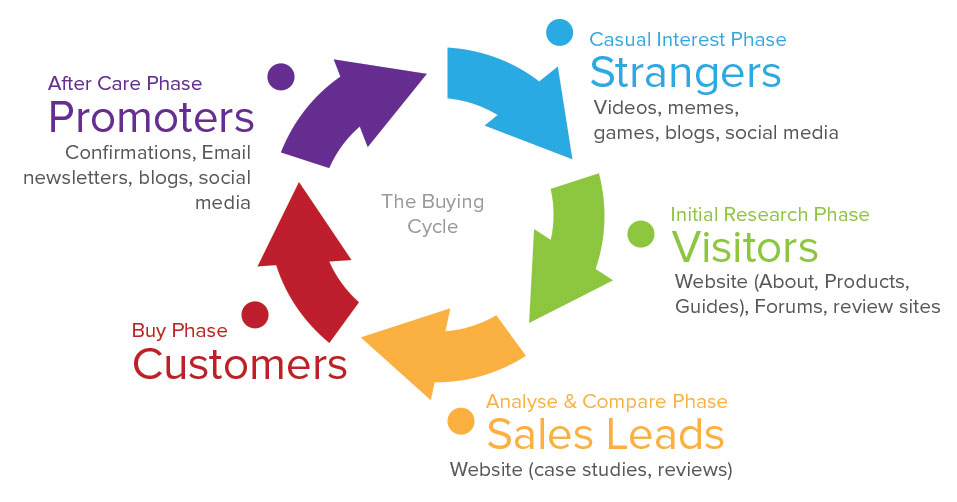
- Check buying cycle. The buying cycle identifies customers at all different stages. See our diagram below. Does your existing online content speak to the customers at every phase? Where are the gaps? Identify and list those gaps.
- Identify what customers are looking for. Identify what the audience at these gaps are looking for. Promoters (satisfied customers) are your biggest cheerleaders and they are one of your best marketing assets. Keep the warm fuzzy feeling going by staying in touch, via newsletters, online offers and social media. Strangers are a more distant prospect and have very different needs. Forget about what you are trying to sell for a moment. What are your potential customers looking for? You could go so far as to create some simple personas. Fill in names, ages, stage in life, family, work and so on - this could help in trying to understand things from their point of view. What online channels can you best use to speak to them?
- Reuse and repurpose. Not Turkey Curry again! Identify existing resources you might have that could be repackaged or repurposed to fill these gaps. Perhaps your blog posts could be collated into an ebook or your training videos made available as a unique web series. Maybe you regularly receive positive feedback via email - what about including this on external sites such as LinkedIn or review sites? Leveraging is a term used to take what you do everyday and max the value. Leverage your existing expertise and content to create a richer landscape for your potential customers.
- Map it out .Time to get planning. How does your team usually plan a schedule? Whether it's Google Calendar or a good old-fashioned wallplanner, get stuck in with markers or mouse and begin to schedule in time. Firstly, map out the areas you DO cover. If you currently update your blog once a month, mark it in. How can you improve this? You could keep it fresher by committing to updating your blog weekly, rather than in an idle moment every month or so, or by making sure the data is up-to-date on your site, and so on. Now, what about the gaps? Start with the existing content that you can repackage or repurpose. You have probably already an idea what new guises this can take. Say you are starting a new YouTube channel - plan out the time it will take to populate that channel with your existing content. You can plan time to start creating new content further down the line once this is done.
- Commit. Just do it. As with the best plans, it is nothing without action. You have already broken it down into baby steps, with your week by week planner. This will help with delegating - look at the strengths of the team around you and decide who takes on what - and make it part of your office 'culture'.
For further advice on your Content Marketing strategy why not contact us?